
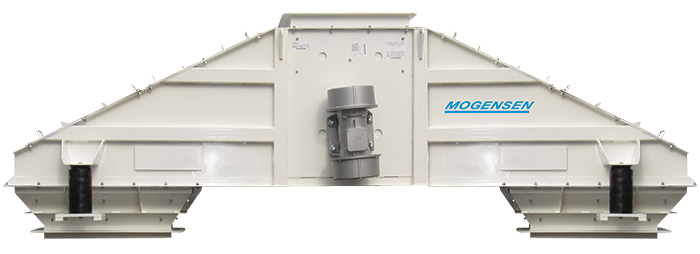
Our Grizzly Feeder is designed to enhance your screening process by providing a consistent and even flow of material to your vibratory screen. It is essentially a vibrating tray that is lined with steel bars, called grizzly bars. The bars are set at a specific spacing, which allows smaller pieces of material to fall through while larger pieces are directed to the vibratory screen for further processing.
Typically installed under feed hoppers, grizzly feeders can handle up to 2m3 material with capacities up to 8000tph. Depending on the application our linear motion feeders require either a 2 shafted or 4 Shafted Vibrator Unit to drive the machine.
Designed for use in a variety of industries including; quarrying, recycling, industrial processing, mining, sand and gravel operations, and a wide range of mineral processing industries. Grizzly Feeders are ideal for handling large, bulky materials such as ore, rocks, and demolition debris




Can’t find what you’re looking for? Maybe these FAQs could help.
A grizzly feeder is a heavy duty vibratory feeder that also acts as a coarse material separator. It is a vibrating tray lined with spaced steel bars, called grizzly bars. As material is fed in, smaller pieces fall between the bars while oversize rock is carried forward. The robust design lets it absorb the heavy shock loads from loaders, trucks and shovels in primary feed applications.
A grizzly feeder vibrates a bar-lined tray so material moves forward in a steady, even flow. The gaps between the grizzly bars let fines and smaller pieces drop through and bypass the next stage, while oversize material passes over the bars, usually on to a crusher or screen. This protects downstream equipment and improves screening efficiency. Most grizzly feeders use a linear vibrating drive powered by twin out-of-balance units.
Grizzly feeders provide a consistent, even feed of material while scalping out fines and separating oversize before crushing or screening. They are ideal for large, bulky materials such as ore, rock and demolition debris. They are widely used in quarrying, recycling, mining, sand and gravel operations and other mineral processing industries.
Grizzly feeders are built for high-capacity primary duty. Larger units can accept a couple of cubic metres of material at a time and handle capacities running to thousands of tonnes per hour, depending on size and duty. The exact capacity depends on the feeder width and length, the bar spacing and the material, so machines are normally sized to the application.
A standard vibratory feeder simply moves material in a controlled flow. A grizzly feeder does the same but also separates material, because its tray is lined with spaced grizzly bars that let fines fall through while oversize passes over. Grizzly feeders are also built heavier to take the shock loads of primary feed duty. In short, a grizzly feeder is a vibratory feeder with an integrated coarse screening stage.
In mining and quarrying, a grizzly is a set of heavy, spaced bars used to separate oversize rock from finer material, usually ahead of a primary crusher. A grizzly feeder combines this bar-screening action with a vibrating feeder, so it both meters the feed and scalps out fines and oversize in one machine, protecting the crusher and steadying the flow.
Grizzly bars can be set in horizontal, sloped or stepped arrangements, in various lengths, and are often hard faced for wear resistance. The spacing between the bars sets the size at which material is separated and is chosen to suit the application. Bars and wear liners are usually replaceable, so worn parts can be changed without replacing the whole feeder.
Grizzly feeders are designed for heavy duty with low maintenance. Typical maintenance includes regular inspection of the grizzly bars and wear liners, checking the vibrator drive and fixings, and replacing wear parts as needed. Because the bars and liners are replaceable, planned checks help maximise uptime and extend the life of the machine.