
Our food processing screening equipment is made in Grantham and specified around your product, your line layout and your hygiene regime rather than pulled off a shelf.
Food is the least forgiving industry we work in. The screen has to hit a grading specification, survive daily washdown, come apart for inspection without tools, and do all of it without becoming the thing that fails your next audit. Get any one of those wrong and the machine becomes a problem rather than a solution.
Screening separates a product stream into fractions by particle size. In food that usually serves one of three jobs: taking out oversize and undersize so what leaves the line meets specification, removing foreign material and agglomerates before packing, or presenting a consistent, even flow to whatever comes next.
A vibratory screen drives the bed of product across an inclined deck. The motion makes the load stratify, so fine particles work down to the deck surface while larger pieces ride on top. Anything under the aperture drops through. Anything over carries on to the discharge end.
The mechanics are the same as in any other industry. What changes in food is everything around them: the materials the machine is made from, how quickly it can be stripped and cleaned, how gently it treats the product, and whether it can be evidenced to an auditor.
Most enquiries we get about food grade screening equipment focus on throughput. Throughput is the easy part. These are the things worth pinning down before you sign anything.
Contact materials and documentation. Ask what every product contact surface is made from, including the screen media, seals and gaskets, and ask for the paperwork. If the machine will handle food in the UK or EU, the contact materials should be supported by declarations of conformity to the relevant food contact regulations. Do not accept “it is stainless” as an answer. Specify it, and get the documentation with the machine.
Stainless grade. 304 is fine for dry, non-corrosive products. Move to 316 where you have salt, acids, brines or aggressive cleaning chemicals, because chloride pitting on a 304 deck will find you eventually. It is a cost difference at the quote stage and an expensive one to retrofit.
Welds and finish. Continuous, ground and polished welds. No crevices, no lap joints and no hollow sections where product can lodge and sit. This is the detail that separates a machine built for food from a general industrial machine with a stainless skin.
Strip-down. How long does it take to open the machine, get the decks out and put it back? Can one person do it without tools? A screen that takes forty minutes to strip will not get cleaned properly on a busy Friday night, whatever the procedure says.
Drainage. Everything that gets wet should drain. Flat horizontal ledges hold water, and water that sits is a microbiological problem waiting to be written up.
More than fifty years of supplying the food processing industries, directly and through OEMs, means we have run most things across a deck at some point.
Vegetables. Brussels sprouts, swedes, potatoes, carrots and bean sprouts. Wet, heavy, easily bruised and rarely a neat shape. Grading these is as much about how gently the product is handled as about the aperture.
Grains and pulses. Seeds, rice, nuts and pulses. Free-flowing, well behaved and usually about a tight cut between two size bands rather than a rough split.
Cereals. Raw materials, flake and granular. Flake is fragile and low in bulk density, so it needs more deck area than the tonnage figure suggests and a gentler action than you would use on a mineral.
Coatings and ingredients. Breadcrumbs, herbs, spices, salt, raising agents, yeast and flavourings. Fine, often hygroscopic, and the group most prone to blinding a screen.
Beverages. Coffee, cocoa powder and granules, and tea. Cocoa in particular is sensitive to moisture and warmth, and behaves differently in August than it does in January.
Sugars. Predictable to screen, unforgiving about moisture pickup.
If your product is not on that list, it does not mean we have not handled something that behaves like it. Bulk density, moisture, particle shape and fragility tell us more than the product name does.
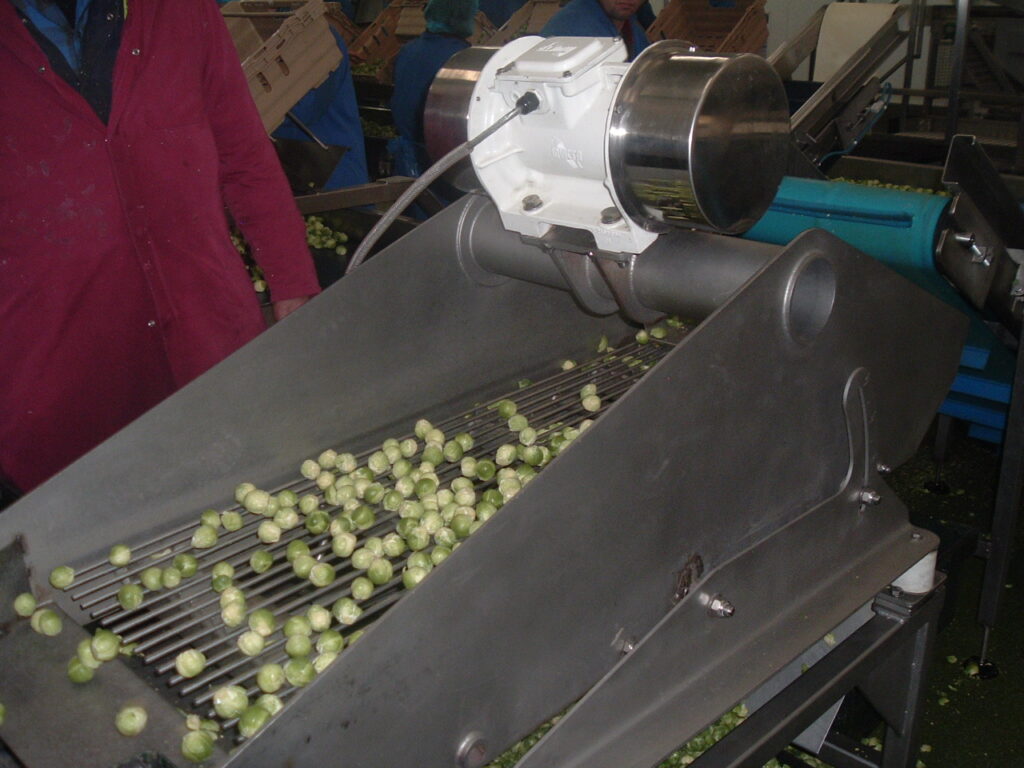
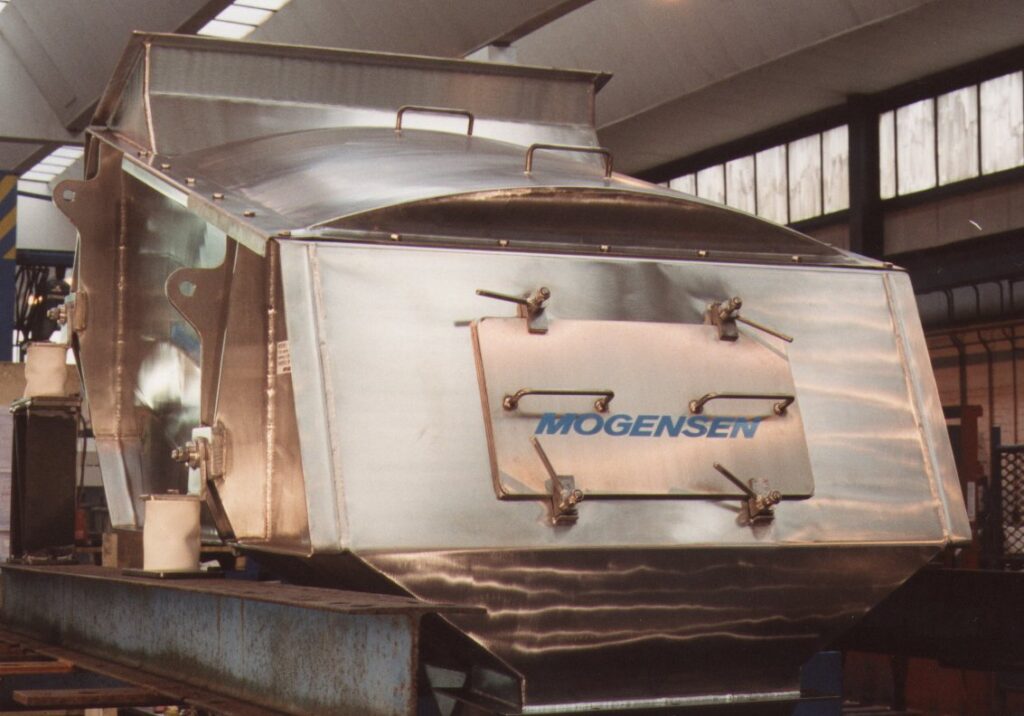
Search for food screening equipment and you will mostly find round sieves and sifters. They are good machines, and for a single-deck check-sieve on a powder line they are often exactly the right answer: compact, simple, and well suited to scalping tramp material out of a flour or a powder before packing.
They are not what we build, and the difference matters when you are choosing.
A round sifter is at its best doing safety screening on one cut, usually on a fine powder, in a small footprint. If that is your duty, buy one.
A rectangular vibratory screen earns its place when you need more than one cut, when the product is coarse or graded rather than a fine powder, when throughput is high, or when the product needs conveying along the deck as well as separating. Multiple decks give you multiple products from one machine. A long deck gives near-size particles the time and presentations they need to pass.
Most plants that come to us have tried to do a grading duty on a machine designed for check-screening, and found the cut is not sharp enough. That is the honest dividing line between the two.
The Mogensen Sizer. Several steeply inclined decks with progressively narrower apertures, working on the probability principle rather than conventional screening. A particle gets many chances to pass through an aperture considerably larger than itself, which means high throughput in a small footprint and much better behaviour on near-size material than a flat deck manages. Detail is on the Mogensen Sizer page.
Vibratory screens. Multi-deck vibratory screens built to the deck configuration, aperture, drive and finish your product and your hygiene regime need.
Feeders. Controlled, even presentation of product to the screen. This is not a detail. Feed presentation is one of the largest single influences on screening efficiency, and a screen fed by a surging conveyor will never perform to its specification. Our range is on the feeders page.
Conveyors. Vibratory conveyors move product along a line with no rotating parts in contact with it, which is why they suit fragile products such as biscuits, crackers and crisps that a belt transfer would break.
Where grading needs to be combined with removing foreign material, sorting equipment sits alongside the screen rather than replacing it.
Blinding. Fine, damp or fatty products lodge in the apertures and progressively close the deck off. Spices, breadcrumbs and anything hygroscopic are the usual culprits. Blinding rarely announces itself. Throughput drifts down over a fortnight, the fine fraction gets dirtier, and it gets blamed on the raw material. Changed media, a different aperture shape, ball decks or a heated deck will usually fix it.
Moisture. Surface moisture makes fines stick to each other and to larger pieces. A product that screens perfectly in a dry warehouse in July can be a problem in February. If your raw material is stored anywhere that moves with the weather, design for the worst month rather than the average one.
Bulk density. The most commonly missed number in a specification. Cereal flake at a low bulk density needs far more deck area than the same hourly tonnage of sugar. Quote a screen on tonnage alone and it will disappoint.
Product fragility. Some products cannot take an aggressive action without breaking, and breakage shows up as an unexplained rise in fines. Amplitude, frequency and deck angle all come into that balance, and it is worth being explicit about it at the specification stage.
The screen has to fit the way your plant actually runs.
If you wet clean, the machine needs to be built for it: drive protected, drainage designed in, and no pooling. If you dry clean, the priority shifts to fast, complete access so that nothing is left behind in a corner.
Changeover time is worth quantifying honestly. If you run several products a day, the minutes spent stripping and rebuilding the screen are real production hours over a year, and a machine that is quicker to open often pays back the difference in a season.
Allergen segregation is the one people leave until commissioning. If you handle an allergen on the same line, decide early whether the answer is validated cleaning between runs or dedicated decks and media, because the second changes the specification of the machine.
Machines are built at our works on Harlaxton Road in Grantham, so the people who design them are the people you speak to when something needs changing. We hold spares for the equipment we supply, and screen media, springs, drive components and wear parts do not carry a long lead time from overseas.
On a food line, that matters more than the price on the quote. An unplanned week down costs more than the gap between the cheapest machine and the right one.
Every food product behaves differently on a deck, and the honest answer to most screening questions is that we would want to understand your product and your process before recommending a machine. We are happy to look at a sample, visit the plant, and tell you plainly if a screen is the right answer.
Get in touch with our engineers to discuss your application, or call 01476 566301.
Can’t find what you’re looking for? Maybe these FAQs could help.
Food, animal feed, recycling, waste management, mining, quarrying, aggregates, construction and chemicals. The mechanics are shared across all of them. What changes between industries is materials of construction, hygiene requirements and how the machine is cleaned and maintained.
Machines for food duties are built with stainless product contact surfaces and can be supplied with documentation covering the contact materials. The exact grade, finish, seal and gasket materials and the accompanying paperwork are specified per machine, so tell us your product, your cleaning regime and the standards you are audited against and we will confirm what is supplied.
The structure typically lasts decades in food service, because the loads are lighter and less abrasive than in mining or aggregates. Wear parts are the shorter cycle: screen media, springs and drive components are consumables and their life depends far more on your product and duty than on the machine.
It depends on deck area, the number of cuts you need, stainless grade and finish, and whether the machine is being built for wet or dry cleaning. There is a genuine spread between a single-deck screen for one straightforward cut and a multi-deck machine in 316 with full washdown protection, so a number without a specification behind it would be misleading.
No. We build rectangular vibratory screens, Sizers, feeders and conveyors. If your duty is a single-deck check-sieve on a fine powder, a round sifter supplier will serve you better and we would tell you so.